
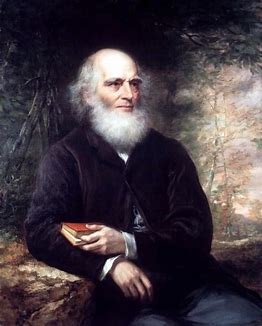
Thanatopsis.
Thanatopsis, William Cullen Bryant (1794-1878)
(Traducido al español por Sebastián Beringheli para El Espejo Gótico)
(sugerencia de publicación por Ofelia Marull)
A quien por amor a la Naturaleza comulga
con sus formas visibles, ella le habla
un lenguaje diverso; para sus horas más alegres
tiene una voz de alegría, una sonrisa
y elocuencia de la belleza,
ella se desliza en sus cavilaciones más oscuras
con una simpatía suave y curativa
que nos roba la agudeza antes de que nos demos cuenta.
Cuando los pensamientos de la última hora amarga
lleguen como una plaga sobre tu espíritu,
y las tristes imágenes de la severa agonía,
y el sudario, y el velo, y la oscuridad sin aliento,
y la casa estrecha, te hagan estremecer y enfermen tu corazón;
colócate bajo el cielo abierto,
y escucha las enseñanzas de la Naturaleza,
mientras de todas partes
—la tierra y sus aguas, las profundidades del aire—
llega una voz apacible.
Pero en pocos días el sol que todo lo contempla
no se verá más en su curso; ni en el frío suelo
donde descansa tu pálida forma,
ni en las lágrimas ni en el abrazo del océano existirá tu imagen.
La tierra que te nutrió reclamará tu crecimiento,
para ser de nuevo tierra resuelta, y, perdido todo rastro humano,
entregando tu ser individual,
te mezclarás para siempre con los elementos,
serás hermano de la roca insensible y el terrón perezoso
que el rudo joven pisotea.
La encina echará sus raíces y traspasará tu moho.
Sin embargo, no te irás solo a tu lugar de descanso,
ni podrías desear un lecho más magnífico.
Te acostarás con los patriarcas del mundo infantil,
con los reyes, los poderosos de la tierra,
los sabios, los buenos, las bellas formas
y los ancianos videntes de edades pasadas,
todos en un poderoso sepulcro.
Las colinas, antiguas como el sol,
los valles que se extienden en medio de una quietud pensativa;
los bosques venerables, ríos que se mueven con majestuosidad,
y los arroyos quejumbrosos que hacen reverdecen los prados;
los residuos grises y melancólicos del viejo Océano,
no son más que los solemnes adornos de la gran tumba del hombre.
El sol de oro,
los planetas, toda la infinita hueste del cielo,
están brillando sobre las tristes moradas de la muerte
a través del silencioso lapso de los siglos.
Todos los que pisan el globo
son sólo unos pocos para las tribus que duermen en su seno.
Toma las alas de la mañana,
atraviesa el desierto de Barcan,
o piérdete en los bosques continuos donde corre el Oregón,
y no escucharás ningún sonido, salvo el tuyo,
sin embargo, los muertos están allí:
y millones en esas soledades,
desde que comenzó el vuelo de los años,
se han echado para su último sueño:
los muertos reinan solos.
Así descansarás, ¿y si te retiras en silencio de los vivos,
y ningún amigo se da cuenta de tu partida?
Todo lo que respira compartirá tu destino.
Los alegres se reirán cuando te hayas ido,
la cría solemne de la preocupación seguirá adelante,
y cada uno como antes perseguirá a su fantasma favorito;
sin embargo, todos estos dejarán su alegría y sus ocupaciones,
y vendrán y harán su lecho contigo.
Mientras el largo tren de las eras se desliza,
los hijos de los hombres, la juventud en la verde primavera de la vida,
y el que se va en la plenitud de los años,
la matrona y la doncella, el niño mudo y el hombre de cabello gris.
serán uno a tu lado, esperando a aquellos que los seguirán.
Vive de tal manera que, cuando llegue tu llamada
para unirte a la innumerable caravana
que se mueve hacia ese reino misterioso,
donde cada uno ocupará su habitación
en los silenciosos pasillos de la muerte,
no vayas como el esclavo de la cantera en la noche,
sino sostenido y aliviado por una confianza inquebrantable,
acércate a tu tumba, como quien se envuelve en las cortinas de su lecho
y se acuesta a sueños placenteros.
Thanatopsis
To him who in the love of Nature holds
Communion with her visible forms, she speaks
A various language; for his gayer hours
She has a voice of gladness, and a smile
And eloquence of beauty, and she glides
Into his darker musings, with a mild
And healing sympathy, that steals away
Their sharpness, ere he is aware. When thoughts
Of the last bitter hour come like a blight
Over thy spirit, and sad images
Of the stern agony, and shroud, and pall,
And breathless darkness, and the narrow house,
Make thee to shudder, and grow sick at heart;—
Go forth, under the open sky, and list
To Nature’s teachings, while from all around—
Earth and her waters, and the depths of air—
Comes a still voice—
Yet a few days, and thee
The all-beholding sun shall see no more
In all his course; nor yet in the cold ground,
Where thy pale form was laid, with many tears,
Nor in the embrace of ocean, shall exist
Thy image. Earth, that nourished thee, shall claim
Thy growth, to be resolved to earth again,
And, lost each human trace, surrendering up
Thine individual being, shalt thou go
To mix for ever with the elements,
To be a brother to the insensible rock
And to the sluggish clod, which the rude swain
Turns with his share, and treads upon. The oak
Shall send his roots abroad, and pierce thy mould.
Yet not to thine eternal resting-place
Shalt thou retire alone, nor couldst thou wish
Couch more magnificent. Thou shalt lie down
With patriarchs of the infant world—with kings,
The powerful of the earth—the wise, the good,
Fair forms, and hoary seers of ages past,
All in one mighty sepulchre. The hills
Rock-ribbed and ancient as the sun,—the vales
Stretching in pensive quietness between;
The venerable woods—rivers that move
In majesty, and the complaining brooks
That make the meadows green; and, poured round all,
Old Ocean’s gray and melancholy waste,—
Are but the solemn decorations all
Of the great tomb of man.
The golden sun,
The planets, all the infinite host of heaven,
Are shining on the sad abodes of death,
Through the still lapse of ages. All that tread
The globe are but a handful to the tribes
That slumber in its bosom.—Take the wings
Of morning, pierce the Barcan wilderness,
Or lose thyself in the continuous woods
Where rolls the Oregon, and hears no sound,
Save his own dashings—yet the dead are there:
And millions in those solitudes, since first
The flight of years began, have laid them down
In their last sleep—the dead reign there alone.
So shalt thou rest, and what if thou withdraw
In silence from the living, and no friend
Take note of thy departure? All that breathe
Will share thy destiny. The gay will laugh
When thou art gone, the solemn brood of care
Plod on, and each one as before will chase
His favorite phantom; yet all these shall leave
Their mirth and their employments, and shall come
And make their bed with thee. As the long train
Of ages glide away, the sons of men,
The youth in life’s green spring, and he who goes
In the full strength of years, matron and maid,
The speechless babe, and the gray-headed man—
Shall one by one be gathered to thy side,
By those, who in their turn shall follow them.
So live, that when thy summons comes to join
The innumerable caravan, which moves
To that mysterious realm, where each shall take
His chamber in the silent halls of death,
Thou go not, like the quarry-slave at night,
Scourged to his dungeon, but, sustained and soothed
By an unfaltering trust, approach thy grave,
Like one who wraps the drapery of his couch
About him, and lies down to pleasant dreams.
William Cullen Bryant (1794-1878)
 La voz vegabajeña